
Menu
The Nursing Home Crisis Is Real, And It Can Wipe You Out. Here's How to Protect Yourself
March 11th, 2026
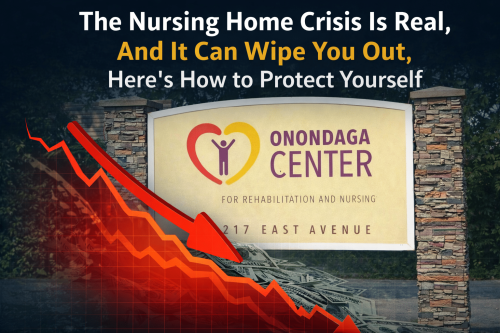
Two stories have been making the rounds in Central New York recently, and if you have a parent, spouse, or loved one who may one day need nursing home care, they should shake you to your core.
The first: Kimberly Townsend, President and CEO of Loretto, one of CNY's most respected nonprofit long-term care providers, sounded the alarm in a public letter to Syracuse.com warning that New York's long-term care system is in freefall. More than 40 nursing homes have closed statewide since 2014, nearly 20% of them in just the past two years. In 2025 alone, 13 adult care facilities shut their doors. According to the article, right here in Central New York, more than 80% of nursing home beds are operated by facilities that are losing money. The funding gap between what Medicaid pays and what care actually costs? About $150 per resident, per day according to Townsend.
The second: A resident at Onondaga Centers in Minoa died last summer after staff failed to review life-threatening lab results for days, and then to make matters worse they withheld CPR despite an explicit order to perform it. The facility's own administration allegedly told staff not to report the incident to the New York State Department of Health. Federal inspectors have now flagged Onondaga Centers, Van Duyn, and Bishop Rehabilitation as among the worst-performing nursing homes in the country. We've previously chronicled the struggles at some of these low-performing nursing homes in Central New York here and here. Together, those three facilities represent 35% of Onondaga County's nursing home capacity.
Read that again. Thirty-five percent.
This Is the System Your Family Is Walking Into
We are elder law attorneys in Syracuse. We work with families every day who are navigating the nursing home system, often in crisis, often after a hospitalization, often with no plan. And what we see is a system under enormous strain. The nonprofit providers who genuinely care about their residents are running deficits. The for-profit operators cutting corners are the ones staying afloat, and sometimes, as we saw at Onondaga Centers, the consequences are catastrophic.
Here's the brutal financial reality: the average cost of nursing home care in New York runs well over $200,000 per year. Most families have no idea that Medicare (the health insurance most seniors rely on) covers only a short-term rehabilitation stay, typically up to 100 days, and only under specific conditions. After that, you are on your own to pay.
Unless you plan ahead.
Medicaid Is the Safety Net, But You Have to Qualify, and Qualify the Right Way
Medicaid will pay for long-term nursing home care for those who qualify. But qualification is complicated, the rules are strict, and New York State is actively looking for reasons to deny or delay your application. There is a five-year lookback period that scrutinizes every financial transaction you or your spouse has made. Gifts to children, transfers of the family home, even innocent-looking bank withdrawals can trigger penalties that leave your family without coverage for months or even longer.
The good news: with proper planning, most families can protect a significant portion of their life savings, keep the house in the family, and ensure that their loved one qualifies for Medicaid without having to spend down to poverty first. But that planning has to happen ideally before a crisis, but sometimes even during one.
This is exactly what elder law attorneys do.
You Don't Have to Accept Whichever Bed Is Available
The nursing home quality crisis Dr. Townsend and the state inspection reports describe isn't just a policy problem, it's a consumer protection problem. Families who enter the system without resources, without planning, and without options often end up wherever there is an open bed. That can mean a facility on the federal government's worst-of-the-worst list.
Families who plan ahead, who have preserved their assets, navigated Medicaid properly, and worked with an elder law attorney have choices. They can afford to be selective. They can pay privately at a higher-quality facility while their planning strategy catches up. They can negotiate. They have leverage.
Money, or the right legal structure protecting your money, buys options. Options save lives.
The System Isn't Getting Fixed Overnight. Your Family Can't Wait.
Loretto's CEO is right: Albany needs to act. The underfunding of long-term care is a genuine crisis that is going to get worse before it gets better as more of the Baby Boomer generation ages into needing care. But we're not in the business of waiting for Albany. Our job is to protect the families sitting across the table from us right now.
If you have a parent over 65, a spouse with declining health, or a family member already in a nursing home or heading toward one, you need a plan. Not eventually. Now.
The families who get hurt the most are the ones who wait until there's a crisis, assume Medicare or health insurance will cover it, and then watch their life savings disappear in less than a year. That doesn't have to be your story.
Talk to an Elder Law Attorney Before You Need One.
The Marrone Law Firm, P.C. is a boutique elder law practice in Syracuse, New York focused exclusively on helping families protect what they've built. We handle Medicaid planning, asset protection, irrevocable trusts, and long-term care strategy before the crisis hits and when it already has.
Visit themarronelawfirm.com or call our office to schedule a consultation. Your family's financial security is worth one phone call.
Attorney Advertising